The 6 Best Handheld Gaming Consoles
Handheld gaming has become a pretty broad category. A Steam Deck and a Nintendo Switch 2 might occupy roughly the same space in your bag, but they go about gaming in completely different ways. Then there are Windows handhelds, which trade some console-like simplicity for a much larger PC library and considerably more room to tinker.
The best one, then, isn’t necessarily the handheld that can push the most frames. Screen quality, battery life, controls, software, game compatibility, and simply how comfortable the thing is to hold all matter just as much. These are the models that stand out most right now.
Best Handheld Gaming Consoles Today
Xbox Ally X
The Xbox Ally X gets closer than most Windows handhelds to striking the right balance between power and actually being pleasant to use. Its Ryzen AI Z2 Extreme has plenty of muscle for modern PC games, backed by 24GB of LPDDR5X memory and a 1TB SSD, while the 7-inch 1080p display runs at 120Hz with VRR. An 80Wh battery also gives it far more breathing room away from an outlet than the first generation of Windows handhelds.
What won us over more, though, is the shape. At 715g it isn’t especially light, but those deeper, Xbox-controller-like grips make that weight easier to live with than the number suggests. The speakers are surprisingly good too, and Microsoft’s full-screen Xbox interface does a decent job of hiding some of the usual Windows clutter.
Some is the important word there. This is still a Windows PC underneath, so updates, launchers, pop-ups, and the occasional bit of fiddling haven’t magically disappeared. And although the 1080p 120Hz IPS panel is smooth, it doesn’t have the punchy blacks of the OLED screens on the Steam Deck or ONEXPLAYER 3. Still, if you want one handheld for Game Pass, Steam, other PC storefronts, and demanding games without going completely overboard on size, the Ally X is the one we’d reach for first.
MSI Claw 8 EX AI+
If your priority is squeezing as much performance as possible out of a handheld, things get considerably more interesting with the Claw 8 EX AI+.
MSI’s 2026 Claw moves to Intel’s Arc G3 Extreme processor and B390 graphics, paired with 32GB of LPDDR5X memory. Tom’s Hardware saw it pull ahead of the Xbox Ally X and Legion Go 2 throughout its test suite, sometimes by more than 20 to 30 fps. Cyberpunk 2077, for example, reached 78 fps at 800p on battery power in their testing and remained at 48 fps after stepping up to 1200p. That’s the sort of headroom that lets you worry a little less about immediately knocking every game down to its lowest settings.
The hardware around that chip is solid as well: an 8-inch 1920×1200 120Hz VRR display, Hall-effect sticks and triggers, 32GB of RAM, 1TB SSD, dual Thunderbolt 4 ports, and an 80Wh battery. The catch is hard to miss—the Claw launched around $1,799, and at that kind of money an IPS panel feels stingy when excellent OLED handhelds already exist. At 785g, it isn’t exactly small either.
So no, this isn’t the sensible buy for everyone. But raw performance is one area where the Claw 8 EX AI+ doesn’t need much apologizing.
ONEXPLAYER 3
The ONEXPLAYER 3 feels less like someone built another Steam Deck rival and more like someone asked how much hardware they could squeeze into a portable PC before the word portable started getting questionable.
Its centerpiece is gorgeous on paper: an 8.8-inch 1920×1200 AMOLED display capable of 144Hz, VRR, and HDR. Underneath sits the same new Intel Arc G3 Extreme platform that’s making the MSI Claw 8 EX AI+ so quick, and ONEXPLAYER pairs it with either 24GB or 32GB of LPDDR5X memory and a hefty 85Wh battery.
There’s another trick here. The controllers detach, a kickstand is built into the body, and a magnetic keyboard can turn the whole thing into a tiny Windows laptop. That flexibility makes much more sense if you can see yourself gaming one minute and getting some actual desktop work done the next. The AMOLED panel also gives the ONEXPLAYER something MSI’s similarly powerful Claw doesn’t: proper black levels and the visual pop you’d expect from a device this expensive.
All of this hardware comes with consequences. It’s bulky, much heavier than a Switch 2 or Steam Deck, and current configurations start around $1,499 on ONEXPLAYER’s store. You’re also buying from a much smaller hardware ecosystem than Asus, Valve, or Nintendo.
Still, for someone who wants an over-the-top handheld rather than the safest purchase, the ONEXPLAYER 3 is easily one of the most interesting machines here.
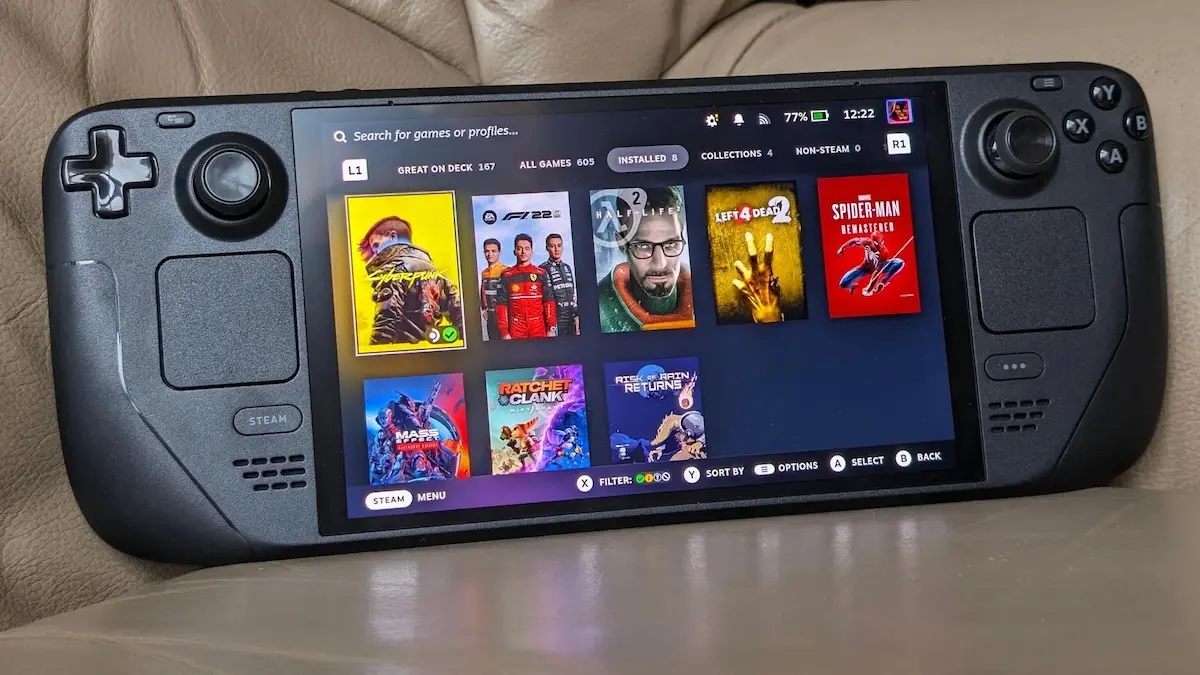
Steam Deck OLED
The funny thing about the Steam Deck OLED is that its processor isn’t particularly impressive anymore. New Windows handhelds can run circles around its Zen 2/RDNA 2 APU in demanding games.
And yet the Deck remains incredibly easy to like.
A lot of that comes down to SteamOS. Wake the system, pick a game, and get playing—the whole experience feels designed around a controller rather than a Windows desktop squeezed onto a seven-inch screen. Valve’s trackpads and four rear buttons also give the Deck more flexibility than a typical console control layout, particularly in PC games originally meant for a mouse.
Then there’s the screen. The 7.4-inch 1280×800 OLED runs at up to 90Hz, can hit 1,000 nits with HDR content, and makes the relatively modest resolution much easier to forgive. The 50Wh battery is rated for roughly 3 to 12 hours depending on the game, and the OLED version weighs about 640g—noticeably less than the big Windows machines above.
There are limits. New AAA games are increasingly capable of pushing the Deck’s aging chip hard, and some multiplayer games with incompatible anti-cheat still make Windows the safer route. Value isn’t quite the slam dunk it once was either: Valve raised the 512GB OLED model to $789 in May 2026 as component costs increased.
Even so, specs don’t tell the entire story here. If your Steam library is already enormous and you’d rather spend your time playing games than tinkering with the machine running them, the Deck OLED still gets a lot right.
Nintendo Switch 2
The Switch 2 isn’t going to beat the MSI Claw in a benchmark, and comparing the two that way kind of misses the point.
Nintendo gives you something Windows handhelds still struggle to replicate: turn it on, launch a game, and everything just works like a console. The new 7.9-inch LCD is a big step up from the original Switch at 1920×1080, with HDR10 and refresh rates up to 120Hz. There’s a custom Nvidia processor under the hood, 256GB of faster UFS storage, magnetic Joy-Con 2 controllers, and docked output reaching 4K/60Hz or 1080p and 1440p at up to 120 fps.
Performance has moved far enough forward that considerably heavier games are practical now, helped by Nvidia’s DLSS technology. More importantly, you’re buying into Nintendo’s own library and a machine that can switch between handheld, tabletop, and TV play without any Windows-style housekeeping. GamesRadar also found it impressively quiet in use and praised the larger screen and improved controls.
Battery life is the bit that takes some shine off it. Nintendo quotes approximately 2 to 6.5 hours, while GamesRadar managed about 2 hours 40 minutes running the demanding Switch 2 version of Breath of the Wild at full brightness; lighter games stretched beyond four hours.
That’s not great endurance, but the Switch 2 doesn’t need to be a tiny gaming PC to justify itself. For Nintendo games and a genuinely pick-up-and-play experience, it’s still playing a different game from most of this list.
Retroid Pocket 5
Not everyone needs a miniature PC capable of running Cyberpunk.
For older games, the Retroid Pocket 5 is smaller, simpler, and dramatically cheaper. Its Snapdragon 865 and 8GB of RAM aren’t going to trouble today’s high-end handheld processors, but they’re more than enough for the kind of retro and Android gaming this machine was built around. More importantly, Retroid didn’t cheap out on the part you’ll stare at all day: the 5.5-inch 1920×1080 AMOLED display looks fantastic.
You also get 128GB of UFS 3.1 storage with microSD expansion, active cooling, analog triggers, Hall-effect sticks, Wi-Fi 6, Bluetooth 5.1, Android 13, and a 5,000mAh battery. Retro Game Corps singled it out as an exceptionally strong handheld in its price class, particularly because the screen, controls, and overall package punch well above what you’d expect from a roughly $200 device.
Just know what you’re buying. This isn’t a Steam Deck replacement and it isn’t intended to brute-force current AAA PC games. The Snapdragon 865 is older silicon, and more demanding modern-console-class workloads quickly expose its ceiling.
But that’s also why the Pocket 5 makes sense. You aren’t paying for power you’ll never use. For a compact device centered around legally owned retro titles and Android games, it hits a very appealing sweet spot between screen quality, performance, and price.