Best Desk Lamps for Your Workspace
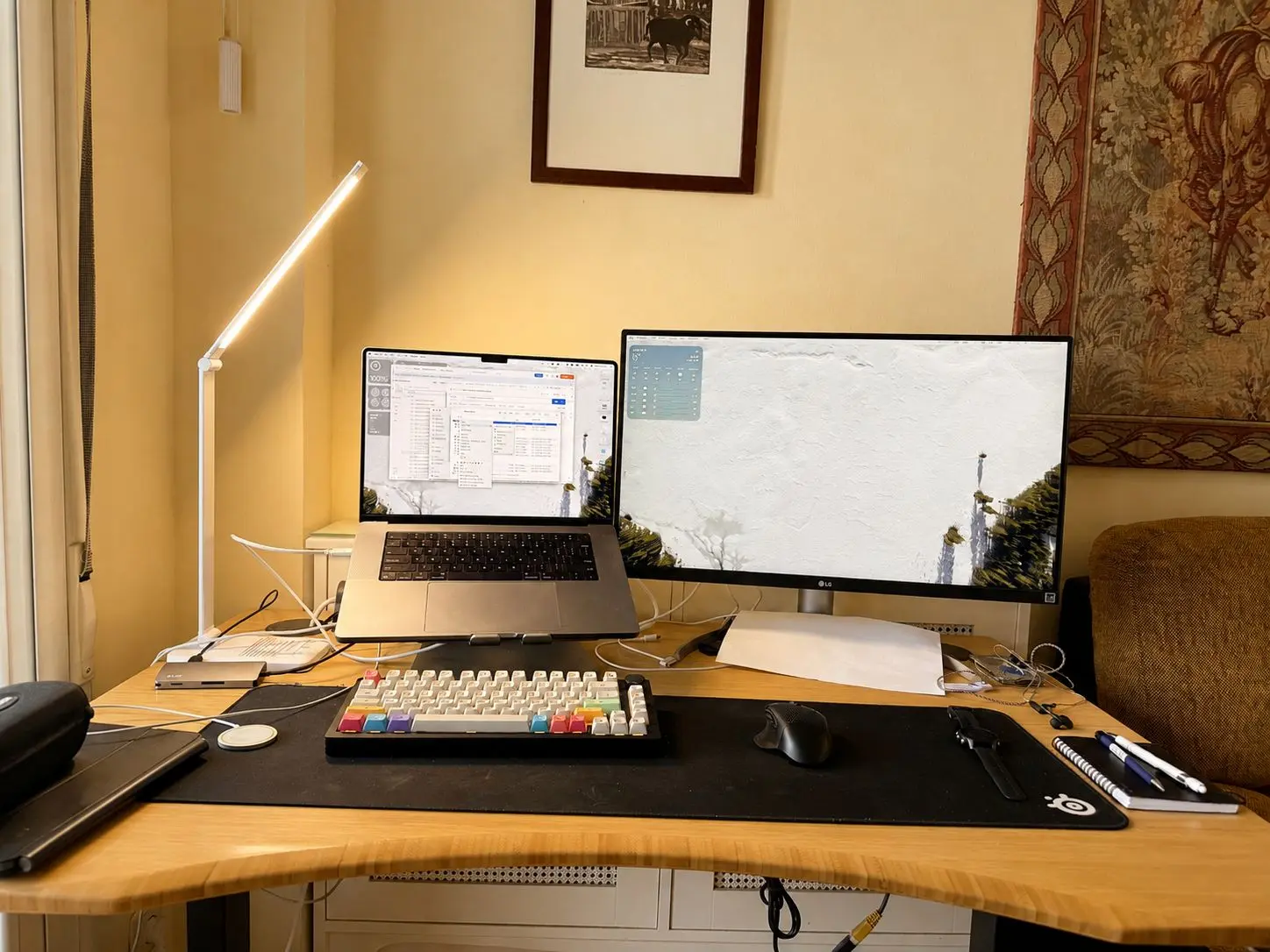
A desk lamp should brighten the work in front of you without shining into your eyes, crowding your keyboard, or turning every adjustment into a two-handed project. The best models do this quietly: They spread light evenly, move where you need them, and make their controls easy to understand.
Our picks range from a compact architectural lamp to an unusually smart….and unusually expensive, Dyson. For this guide, we prioritized manufacturers’ published specifications, including brightness, color rendering, adjustability, controls, and warranty. Seller-provided figures are identified where applicable.
Our Picks
- Best overall: Koncept Z-Bar Mini Desk Lamp
- Best budget lamp: Honeywell HWT-H01
- Best for a large desk: BenQ e-Reading LED Swing Arm Desk Lamp
- Best smart desk lamp: Dyson Solarcycle Morph CD06
- Best bright lamp for the price: LitONES F-630
Honeywell HWT-H01
- Close to Natural Light - More Comfortable
- Eye Care Dimmable Tech & 3 Color Modes
- Two Charging Ports - USB A+C
- More Vivid and Accurate Colors
- Portable Foldable Desk Lamp

At a quite affordable price from the official store at the time of publication and you can find one with better price at amazon, the Honeywell HWT-H01 gets an unusual number of fundamentals right. Its frosted panel produces up to 500 lumens, brightness adjusts from 15 to 100 percent, and three color settings….3,000 K, 4,000 K, and 5,500 K, cover everything from relaxed evening reading to cooler task lighting. Honeywell also lists a CRI of 95, along with flicker-free full-spectrum LEDs. Two charging ports, one USB-A and one USB-C, are built into the lamp, although they are better treated as convenient extras than fast chargers. These figures come from Honeywell’s official HWT-H01 product page.
The arm folds through 180 degrees, leaving a compact shape that fits easily on a dorm desk or bedside table. That makes the HWT-H01 a practical choice for students, readers, crafters, and anyone working in a small apartment. Its short arm cannot reach across a large monitor setup as gracefully as the Koncept or BenQ, but that is a reasonable limitation at this price.
Koncept Z-Bar Mini Desk Lamp
- Built in touch strip for multi-level dimming
- Built in touch strip for multi-level dimming
- Optional occupancy sensor
- Multiple mounting options
- Efficient LED Lighting

Most desk lamps announce themselves with a bulky shade or an oversized base. The Z-Bar Mini takes the opposite approach. Its slender aluminum arms nearly disappear beside a monitor, yet the articulated design lets you place the light over a notebook, keyboard, or drawing surface without moving the entire lamp.
The standard Gen 4 model produces a manufacturer-rated 533 lumens, uses just 5.7 watts, and has a CRI of 90. A touch-sensitive strip on the lamp head handles multilevel dimming, while the diffused optics are designed to soften the multiple shadows that exposed LEDs sometimes create. Koncept also rates the LEDs to maintain 90 percent of their output beyond 60,000 hours.
Flexibility is the stronger reason to buy it. The lamp works with a traditional base, desk clamp, through-table mount, wall mount, or optional wireless-charging base. That range makes the Z-Bar Mini particularly well suited to small home offices, design studios, drafting tables, and carefully arranged workspaces where every inch matters.
It is not the feature bargain of this group. The standard version comes in either 3,500 K or 5,000 K rather than allowing you to move freely between warm and cool light. The more expensive Mini Pro adds adjustable 2,700 K–5,000 K lighting, an occupancy sensor, USB-C charging, and additional brightness. If you simply want an inexpensive lamp for homework, buy the Honeywell. The Koncept makes sense when precise positioning and unobtrusive design matter just as much as brightness.
BenQ e-Reading LED Swing Arm Desk Lamp
- Ultrawide Illumination
- 2 Smart-Dimming Modes
- Customizable Colors & Brightness
- Adjustable Arm & Angle
- Safe Light Source

A wide desk changes the job of a lamp. Lighting one notebook is easy; illuminating a keyboard, paperwork, and two monitors without creating harsh contrast takes a broader beam. The curved head on the BenQ e-Reading lamp covers a manufacturer-rated 35.4-inch-wide area, and the adjustable arm can lift that light above a substantial workstation.
BenQ gives you plenty of control over it. The lamp offers 23 brightness levels and 13 color-temperature settings, with a range of approximately 2,700 K to 5,700 K. Screen and paper modes use an ambient-light sensor to adjust the output automatically, while the physical knob makes manual changes straightforward. A ball joint at the head and torque-controlled arm joints let the lamp move through several angles without allowing the head to sag. BenQ’s product page also lists high color rendering and a construction made primarily from metal.
This is the lamp I’d choose for a permanent home office, a dual-monitor workstation, long study sessions, or a desk used for photography and crafts. It is considerably less convincing on a small table. At about 10.6 pounds with a broad head and heavy base, the BenQ occupies more visual and physical space than the Z-Bar Mini. That weight keeps it planted, but it also means you should decide where it will live before bringing it home.
Dyson Solarcycle Morph CD06
- Intelligent lighting in multiple formats
- Multiple lights in one
- Intelligently tracks local daylight
- Designed to improve visibility and help reduce eyestrain.

The Dyson Solarcycle Morph is not the sensible value pick. It is the desk lamp for someone who wants one piece of lighting to perform several different jobs—and is prepared to pay around $650 for that versatility.
In its task position, the CD06 produces a claimed 850 lumens and an average 1,546 lux, with less than 1 percent flicker and a CRI of at least 90. The articulated arm and rotating optical head let you direct the beam onto detailed work or bounce it off a wall when direct light feels too intense. Color temperature ranges from 2,700 K to 6,500 K in task mode.
Dock the head against the stem, and the lamp changes character, producing a warmer 1,800 K–3,400 K ambient glow. It can also function as indirect lighting or point toward artwork, giving it more range outside the office than a conventional task lamp.
The intelligence is useful rather than purely decorative. Dyson’s daylight algorithm adjusts brightness and color temperature according to your location, date, and time; an ambient sensor responds to the light already in the room, and a motion sensor switches the lamp off after five minutes of inactivity. The MyDyson app adds Study, Relax, Wake-up, and Boost modes, along with as many as 20 custom settings.
Designers, photographers, architects, and people who use the same room for work and relaxation will get the most from it. Everyone else should think carefully. The CD06 weighs 7.7 pounds, its LEDs are not replaceable, and its daylight system calculates the expected conditions on a clear day rather than measuring the weather outside. It is a fascinating lamp. It is also several times the price of models that perform the basic job perfectly well.
LitONES F-630
- Professional Eye-Caring Lighting
- Enhance Your Appearance
- Adjustable Swing Arm
- 24/7 Customer Service

The unnamed model in the supplied Amazon link is the LitONES F-630, a tall swing-arm lamp aimed at large desks and video-call setups. According to the Amazon product listing, its 84 LEDs produce up to 1,200 lumens, with three color temperatures….3,000 K, 4,500 K, and 6,500 K, and ten brightness levels. The 26.7-inch frame has several pivot points, so the light can sit above a monitor or angle downward for drawing, model building, paperwork, and other detailed tasks; memory and timer functions make the controls more convenient once you have found a setting you like. At 4.4 pounds with an iron base, it should also be less prone to tipping than an ultralight lamp.
The appeal is easy to understand: It promises more output and reach than the Honeywell without entering BenQ pricing. The reservation is equally important. LitONES has a shorter public track record, and most of the performance information comes from the seller rather than established independent testing. Buy it from a retailer with an uncomplicated return policy, especially if even light distribution and long-term support matter more to you than maximum brightness.
How to Choose a Desk Lamp!
Start with the size of your workspace. A compact lamp is enough for a laptop and notebook, but a large desk or dual-monitor setup needs greater height, reach, and lighting coverage. A clamp saves surface space; a weighted base is easier to move and generally feels more stable.
Look beyond maximum lumens. A very bright lamp can still be uncomfortable if individual LEDs are visible or the beam creates glare on a monitor. Diffusion, positioning, and dimming matter more than winning a brightness contest.
Match color temperature to the task. Warm light around 2,700 K to 3,000 K feels more relaxed in the evening. Neutral light around 4,000 K works well for general reading and office tasks, while cooler settings can make fine details easier to see. Adjustable color is useful if the same desk serves several purposes.
Check CRI for color-sensitive work. A CRI of 90 or higher is preferable for drawing, painting, photography, and crafts because colors should appear more natural. For ordinary documents and keyboard work, adjustability and glare control will usually make a larger practical difference.
Finally, treat wireless charging, apps, timers, and “eye-caring” labels as secondary. These features can improve convenience, but they cannot rescue a lamp that is unstable, difficult to position, or unpleasant to look at for hours.
Final Thoughts!
The Koncept Z-Bar Mini offers the best blend of precise adjustment, compact design, and dependable light quality. Honeywell’s HWT-H01 is the easier recommendation for students and budget buyers, while the BenQ earns its extra size on wide, monitor-heavy desks. The Dyson Solarcycle Morph is a luxury choice with genuinely useful adaptive features. The LitONES F-630 delivers the most ambitious specifications for the money, but its seller-supplied claims and less-established support make it a more cautious recommendation.