Best Emergency Kit Items for Every Kind of Disaster
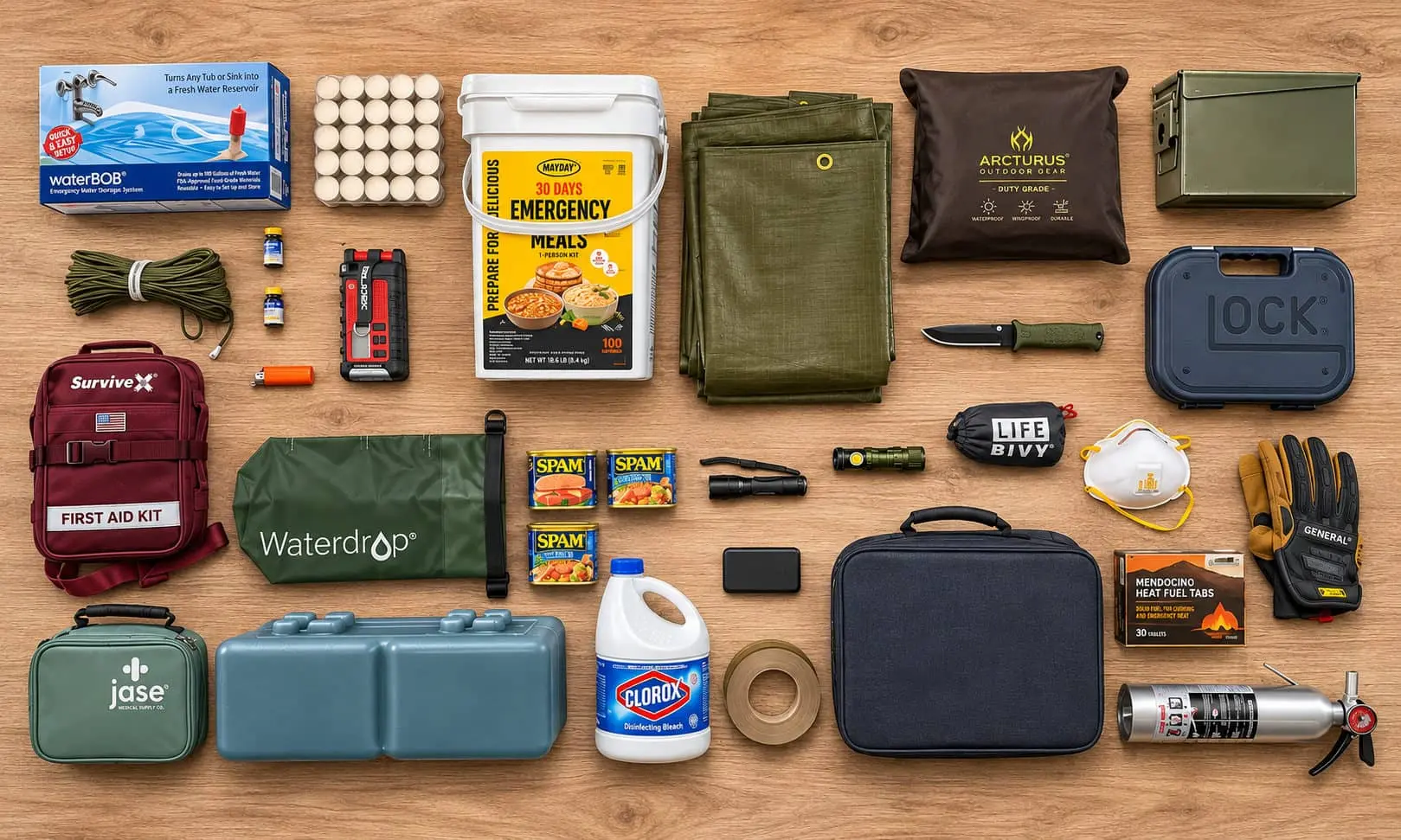
From a three-day blackout to the scenario nobody wants to say out loud, here’s what to keep on hand, organized by the emergency you’re actually preparing for.
The Basics
Building an emergency kit used to feel like homework for a test that would never come. Then came the winter storm that knocked out power for four days, the smoke season that turned the sky orange, and a news cycle that has people Googling “what to do in a nuclear attack” at 2 a.m. The test, it turns out, is not hypothetical. And while we are not suggesting you convert the spare room into a bunker, having a few things ready before you need them is the cheapest peace of mind there is.
The trouble is that most checklists treat every emergency the same. A hurricane, a blizzard, and a radiological event share some needs (water, light, a way to hear the news) and diverge sharply on others. So we organized this list the way emergency planners do: start with a core kit that works for anything, then add a few items for the specific threats where you live.
To build it, we started with guidance from Ready.gov, the CDC, the EPA, the Consumer Product Safety Commission, and the FDA, which is useful but mostly stops at broad categories. For the specifics, we went through what emergency managers, physicians, and radiation scientists have said on the record, and checked each product pick against spec sheets and independent reviews. We kept it lean on purpose: a kit you can actually carry beats a perfect one you can’t lift.
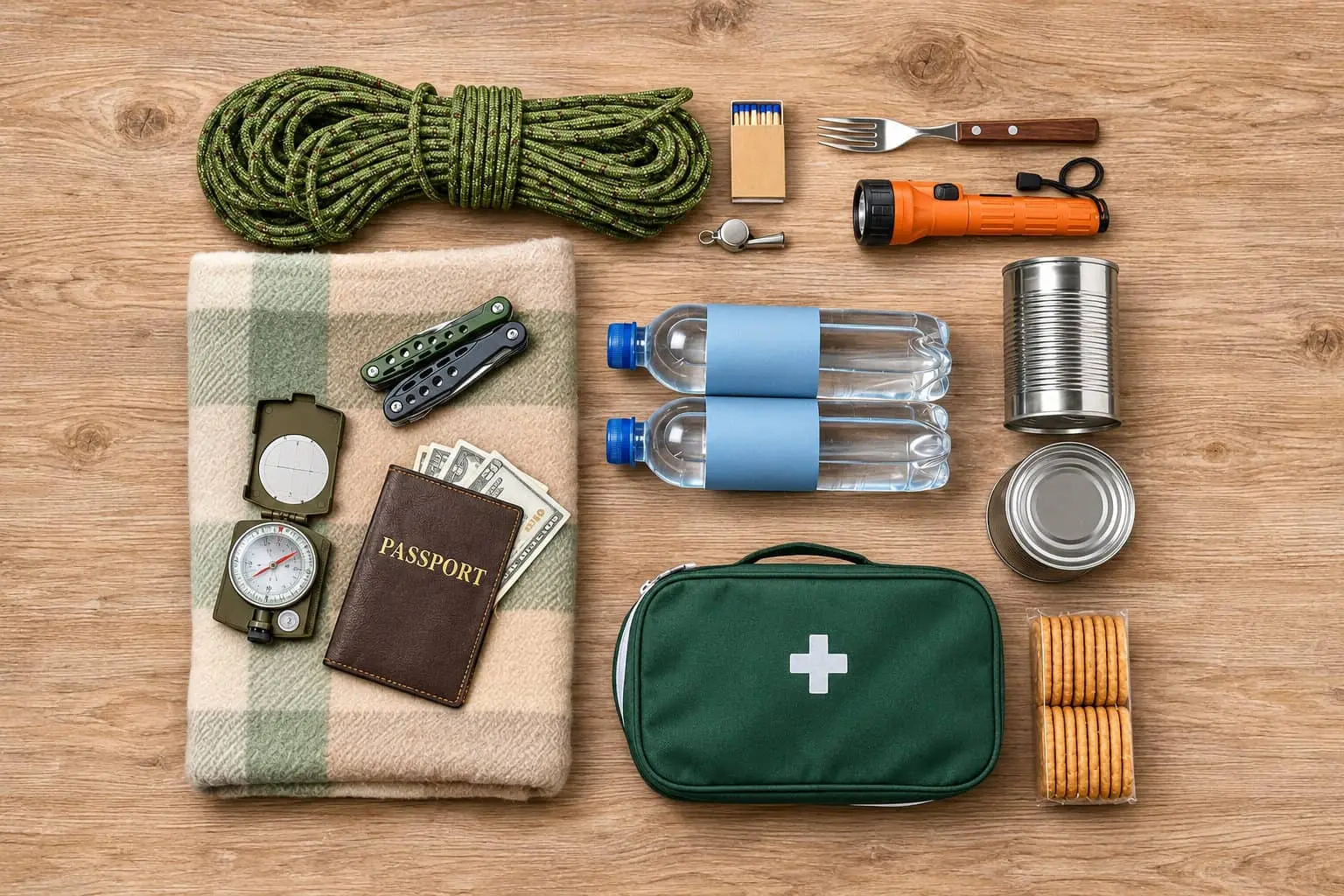
For Every Kit, Whatever the Emergency
Water filter

The standard advice is a gallon of water per person per day, and Joel Haman, the emergency preparedness coordinator at Nebraska Medicine, suggests storing at least a week’s worth to start and swapping it out once a year so it stays fresh. But stored water runs out, and when it does, you need a way to make more. Sawyer’s hollow-fiber filters are the default pick in most prepper and backpacking kits for good reason. The 0.1-micron pores are small enough to strain out bacteria and protozoa, and Sawyer rates them for up to 100,000 gallons if you backflush them regularly.
Two caveats worth knowing: it won’t remove chemicals, and a filter that freezes can crack, so keep it somewhere that stays above 32 degrees.
Emergency food

Stating the obvious: at some point in a crisis, you will get hungry. Canned goods you already eat are the backbone of any pantry stash, but for food that sits untouched for years, freeze-dried meals are hard to beat. Haman calls freeze-dried food “amazing for long-term storage,” and Mountain House is the brand you’ll see on nearly every shelf. Its pouches need only hot water, and the company backs them with a 30-year taste guarantee, which outlasts most mortgages. For a go-bag or a glove box, you want something that needs no water and no stove at all. That’s ERbar: a 72-hour emergency ration formulated specifically for disaster victims, approved by the U.S. Coast Guard, with a five-year shelf life. Each packet contains nine individual 410 calorie rations that are ready-to-eat with no preparation. They taste like a dry coconut shortbread, which is a compliment in this context.
Hand-crank radio

When cell towers go down, a battery or crank-powered radio is how you’ll find out what’s happening. The CDC specifically recommends a NOAA weather radio as one of the best ways to stay informed during a radiation emergency, and it’s just as useful in a tornado or hurricane. Bob Wedgeworth, director of emergency operations for Rankin County, Mississippi, points out that TVs and phones only work until the signal is knocked out, while weather radios keep going on backup power. As for the piercing alert tone people complain about: “If that sound is inconvenient, I’m sorry, but it can save your life,” he told SuperTalk Mississippi.
The Kaito Voyager Pro KA600 is one of the most widely recommended models. It picks up AM, FM, and NOAA weather alerts, and it charges by hand crank, solar panel, or its built-in 2,600mAh battery, which can also top up a phone in a pinch. It has a flashlight and, for reasons we fully support, an ultrasonic dog whistle meant to help rescuers find you.
Headlamp

Flashlights are fine. Headlamps are better, because in an emergency you will almost always need both hands. The Black Diamond Spot 400 is a long-standing favorite among gear reviewers: 400 lumens on high, up to 200 hours on its lowest setting, and an IPX8 rating, meaning it’s built to survive being submerged. It runs on three AAA batteries, which is a feature, not a bug, when you can’t recharge anything.
First-aid kit

Plenty of preppers would rather build their own first-aid kit than buy one. If you don’t have the time, My Medic’s MyFAK is a well-regarded pre-built option. It packs more than 100 supplies into a sturdy CORDURA nylon bag with color-coded pockets, so you’re not digging for gauze in a hurry. Whatever kit you choose, add a few weeks’ supply of any prescription medications you take.
Knife

You don’t need a tactical anything. You need a sharp blade that won’t rust and won’t break your heart if you lose it. The Morakniv Companion, made in Sweden, has a 4.1-inch Sandvik stainless steel blade and is one of the least expensive things on this list.
Winter Storms and Long Power Outages
Portable power station
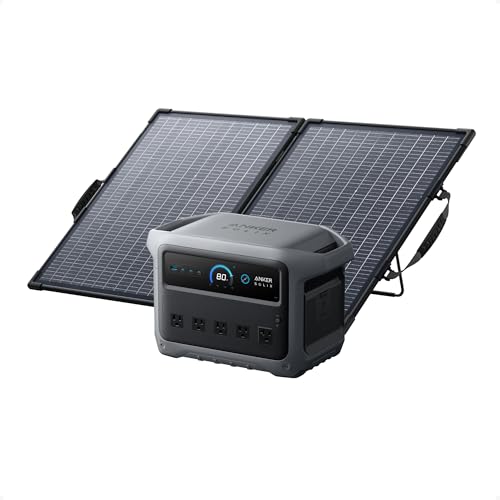
For a long time, backup power meant a gas generator rattling in the driveway. Safety officials are blunt about those: never run one indoors, and a garage with the door open doesn’t count, because carbon monoxide can drift back in. Portable power stations, which are basically very large rechargeable batteries with outlets, have no exhaust at all, which means you can run one beside the couch.
Our top pick is the Anker Solix C1000 Gen 2. It holds 1,024 watt-hours, puts out 2,000 watts, and can refill from empty in 49 minutes when you switch on its fast-charging mode in the app, which matters when the grid flickers back for an hour and then quits again. It also works as an uninterruptible power supply with a switchover under 10 milliseconds, fast enough that a CPAP machine won’t notice the outage.
If you live in a small apartment and mostly need to keep phones, a router, and a lamp going, a 1,000-watt-hour station is overkill. The Jackery Explorer 300 Plus holds 288 watt-hours, weighs about eight pounds, and fits on a bookshelf. A rough rule for either: divide the watt-hours by what your device draws, then shave off 10 to 15 percent for conversion losses.
Emergency bivy

The classic Mylar space blanket is crinkly and, by morning, soaked with condensation on the inside. SOL’s Escape line uses a breathable fabric that still reflects body heat back at you. The Escape Lite weighs 5.5 ounces and packs down small, and you can slip it inside a sleeping bag as an extra layer on a night when the heat is out.
Carbon monoxide alarm
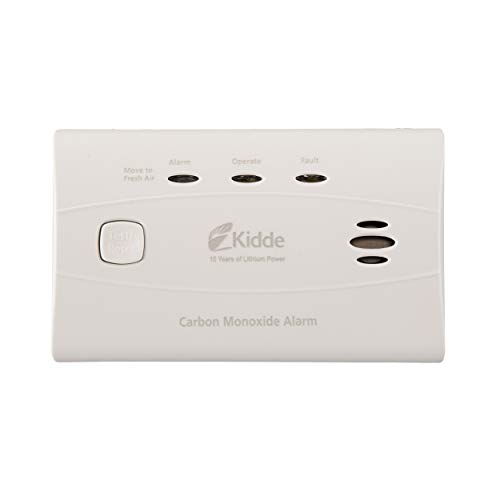
This is the least exciting item on the list and maybe the most important. Winter outages are when people bring grills, camp stoves, and generators too close to the house, and carbon monoxide has no smell. The Consumer Product Safety Commission puts it starkly: “CO poisoning from portable generators can kill whole families in minutes.” The agency counts roughly 100 deaths a year in the U.S. from portable generators alone, and it urges people to test their CO and smoke alarms before a storm hits.
A battery-powered alarm keeps working when the power doesn’t. We like Kidde’s models with a sealed 10-year lithium battery, which means no 3 a.m. low-battery chirp and no temptation to borrow the battery for something else.
Hurricanes, Floods, Wildfires, and Earthquakes
The good news about hurricanes and many floods: they usually come with a warning. The bad news about wildfires and earthquakes: they often don’t. Either way, the job is the same. Have a bag by the door, know where you’d go, and have a way to reach people when the cell network is jammed or gone.
Bathtub water bladder

When a storm is a day out, water mains break and treatment plants go offline, and the bottled-water shelves empty fast. The Godwolf Bathtub is a heavy-duty, food-grade plastic liner that sits in your bathtub, fills from the faucet, and holds up to 100 gallons, with a small hand pump to get the water back out. The company says it keeps water fresh for up to 16 weeks. It’s single-use and inexpensive for what it does.
One caveat: plenty of standard tubs hold well under 100 gallons, so don’t count on the full number.
Satellite messenger

If you want a sense of how fast cell service can vanish, look at Hurricane Helene. Days after the storm, about 370 of North Carolina’s 1,452 cell sites were still out of service, according to the Federal Communications Commission, and whole towns in the western part of the state were cut off. A satellite messenger lets you text family and, if it comes to that, send an SOS to a rescue coordination center from almost anywhere on Earth. Garmin’s inReach line is the standard.
The newest inReach Mini 3, released in late 2025, adds a color touchscreen; the Plus version can also send photos and short voice messages. The older inReach Mini 2 still covers the essentials, SOS and texting over the Iridium network. Whichever you pick, plan for a monthly subscription; the device does nothing without one. (If you have a recent iPhone, its built-in satellite texting is a decent backup, too.)
N95 respirators

Wildfire smoke is mostly fine particulate, and cloth or paper masks don’t filter it. The EPA and CDC both point to respirators marked NIOSH with N95 or P100, worn with a tight seal and two straps that go around your head. Dr. Isabel Pedraza, a pulmonologist who directs the medical ICU at Cedars-Sinai, says N95s offer the best protection but can be hard to wear for long stretches, and she offers a simple test for when to put one on: if you can smell smoke, the air you’re breathing “contains particle pollutants.” The same box earns its keep after an earthquake, when the air fills with dust from drywall and concrete. Buy a box of 20 and stash a few in every bag and glove box.
Nuclear and Radiological Emergencies
This is the section people scroll to first and the one where gear matters least. In a nuclear or radiological emergency, what protects you is mostly where you are, not what you own. The federal guidance from Ready.gov and the CDC fits on an index card: get inside, stay inside, stay tuned. Brooke Buddemeier, a certified health physicist at Lawrence Livermore National Laboratory who has spent years modeling nuclear detonations for FEMA and local responders, sums up why that simple advice matters so much: “Casualties from fallout are almost entirely preventable.”
In practice, that means getting into the nearest sturdy building, ideally brick or concrete, and heading to the basement or the middle of the building, away from outer walls and the roof. Resist the urge to flee. “Don’t get in your car,” Buddemeier has said; a vehicle offers almost no protection from fallout. Plan to stay put for at least 24 hours unless officials tell you otherwise, even if your family is scattered; you reunite later. If you were outside when fallout arrived, take off the outer layer of clothing and wash or wipe down any exposed skin. And because phones and internet may go down, the hand-crank radio from our basics list is suddenly the most important thing you own.
That makes the real kit for this scenario the same core kit above, sized to keep you indoors for a day or more: water, food that needs no cooking, light, a radio, a first-aid kit, and any prescriptions you take. A couple of additions are worth knowing about.
Potassium iodide tablets

Potassium iodide, or KI, is the most misunderstood item in any prepper’s closet, so here are the facts. It does one thing: it floods the thyroid with stable iodine so it won’t absorb radioactive iodine. It does not protect any other organ, and it does nothing against other radioactive materials. Dr. Susan Mandel, director of the Penn Thyroid Center, has stressed exactly this to WHYY: some people treat KI like an all-purpose anti-radiation pill, when its use is very specific. The FDA-approved, over-the-counter products are iOSAT (130 mg tablets), ThyroSafe (65 mg tablets), and ThyroShield (a liquid for children).
The label is explicit that you take it only when public health officials tell you to, not as a precaution. Adults over 40 generally aren’t advised to take it unless exposure is expected to be very high, and anyone allergic to iodine shouldn’t. Buddemeier has also pointed out to Business Insider that KI is one of the last things you need right after a blast, so if you want it, buy it ahead of time rather than making a run to the pharmacy when you should be sheltering.
Plastic sheeting and duct tape
Ready.gov’s basic kit list includes plastic sheeting and duct tape for sheltering in place, and they’re cheap enough to keep in a closet. They’re most useful in a chemical or hazardous-materials release, when you may be told to seal a room against outside air. For fallout, the walls, floors, and distance between you and the outside do most of the work, so think of the sheeting as a backup, not a force field. It doubles as an emergency rain fly, a ground cloth, or a patch for a broken window after a storm.
A Plan!
Every emergency guide ends up in the same place: the gear is the easy part. What actually helps in the moment is a plan you’ve said out loud at least once. Agree on where your household meets if you can’t get home, and pick one out-of-town contact everyone checks in with, since long-distance calls can go through when local lines are jammed. When networks are overloaded, skip the phone call altogether. FEMA’s family communication guide puts it in capital letters: “Text is best.” Short messages often slip through when calls can’t.
Then do the boring maintenance. Put copies of IDs, insurance papers, and prescriptions in a waterproof pouch inside your go-bag. Twice a year, when the clocks change, rotate the water, check the expiration dates on food bars and medications, and top off the power station. Test the radio. Put fresh batteries in the headlamp.
And if all of this feels like a lot, start with the basics and stop there for now. A kit that’s 80 percent done and sitting by the door beats a perfect one still in your cart.