The 5 best space heaters for a quick fix in a freezing home
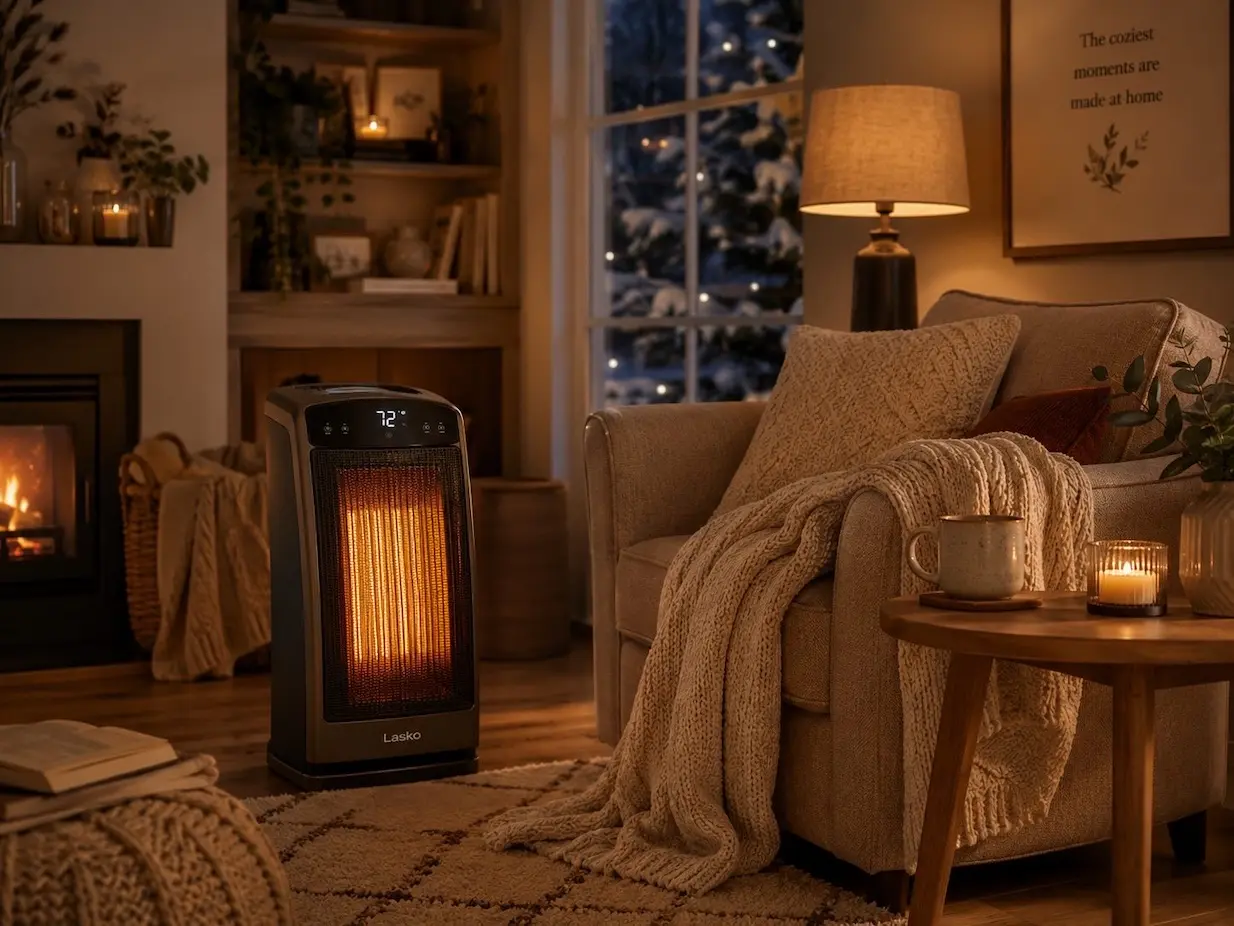
A good space heater should do more than produce hot air. It needs to distribute that heat where you need it, hold a reasonably stable temperature, and shut down reliably when something goes wrong. Extra app controls and oversized displays can be convenient, but they matter less than consistent heating, manageable noise, and basic electrical safety.
To narrow the field, we reviewed highly ranked discussions from communities including r/BuyItForLife, r/Frugal, r/Costco, and r/HomeImprovement. Reddit is not a controlled product test, and users often recommend a heater type or brand rather than one exact model. Still, several names appeared repeatedly: Vornado whole-room heaters, De’Longhi oil-filled radiators, Presto HeatDish models, and simple Lasko ceramic heaters. We then checked current specifications, recent independent testing, and manufacturer safety information before selecting the exact models below.
5 Best Space Heaters of 2026
Vornado VH200
The Vornado VH200 is not the newest or most feature-heavy heater here, but its simplicity is part of the appeal. Reddit users repeatedly praise Vornado whole-room models for distributing heat more evenly than heaters that produce one concentrated blast of hot air. The VH200 uses Vornado’s circulating airflow design rather than oscillation, helping it gradually mix warm air through a closed bedroom, office, or living space.
There are only two control dials: one for the thermostat and another for three heat settings. You do not get a remote, digital temperature readout, timer, or smart controls. However, fewer electronic features also make the heater straightforward to operate. Vornado equips it with tip-over protection, automatic safety shutoff, a relatively cool exterior, and a five-year warranty—considerably longer coverage than Dreo provides for the Whole-Room Heater 714.
The main limitation is temperature precision. Its mechanical thermostat cannot be set to an exact degree, so finding the right position takes some trial and error. It also warms a room more gradually than the directional Presto or the fast-blowing Dreo. Still, the VH200 offers the best balance of unobtrusive noise, useful heat distribution, uncomplicated controls, and long warranty protection. It is the model we would choose for someone who wants dependable supplemental heat without turning another household appliance into a connected gadget.
Best for: Bedrooms, offices, and medium-size enclosed rooms
Skip it if: You want a remote, timer, exact temperature setting, or oscillation
Dreo Whole-Room Heater 714
The Dreo Whole-Room Heater 714 addresses one of the most frustrating weaknesses of inexpensive fan heaters: the temperature sensor. Because a heater’s internal thermostat sits close to the heating element, it can believe the room is warm long before the far side of the space catches up. In independent testing of several dozen heaters, WIRED found that the 714’s thermostat behaved more accurately than most competitors, likely helped by a design that separates the sensor from the hottest components.
Heat distribution is another strength. The unit oscillates both horizontally and vertically, rather than simply sweeping from side to side. Dreo lists six speed levels, a temperature range from 41°F to 95°F, a 1,500-watt ceramic element, and recommended coverage of approximately 161 to 269 square feet. It weighs only 6.45 pounds and includes a remote, making it easy to reposition or adjust from across the room.
The 714 is easier to fine-tune than the VH200, but it is also more complicated. Its controls sit close to floor level, and the on-unit buttons are not particularly easy to see from a standing position. Dreo claims a low 34-decibel operating level, although manufacturer sound ratings are not always directly comparable between brands. Its one-year standard warranty is also short next to Vornado’s five-year coverage.
Choose the Dreo over the Vornado when precise temperature selection, a remote, and wide oscillation matter more than long warranty coverage and mechanical simplicity.
De’Longhi Dragon 4 TRD40615E
The De’Longhi Dragon 4 approaches heating very differently. Instead of forcing hot air through a fan, it warms sealed oil inside the radiator and releases that heat gradually through its metal fins. With no fan moving air, operation is effectively silent aside from occasional clicks as the thermostat cycles.
This is the kind of heater that Reddit users tend to keep for years. In BuyItForLife discussions, De’Longhi oil-filled radiators receive repeated praise for durability and steady warmth, with some owners reporting well over a decade of seasonal use. That does not guarantee that every unit will last as long, but it gives the Dragon a stronger long-term ownership record than newer app-focused heaters have accumulated.
The TRD40615E uses up to 1,500 watts, with lower settings down to 700 watts. It includes digital temperature controls, three heat levels, a 24-hour programmable timer, an anti-freeze mode, thermal shutoff, and a child lock. At approximately 26.6 pounds, it is far heavier than either the Vornado or Dreo, although built-in wheels make moving it across a flat floor manageable.
Patience is the trade-off. An oil-filled radiator takes longer to make a cold room comfortable, and it does not produce the immediate blast of warmth you get from a ceramic fan heater. Once heated, though, it cycles gently and continues releasing stored warmth after the element turns off. It is a particularly good choice for a home office, reading room, or bedroom where quiet, steady heat matters more than rapid warm-up.
Do not interpret its silent operation as permission to leave it running unattended or while sleeping; current CPSC guidance recommends turning portable heaters off before going to sleep.
Presto HeatDish Plus Tilt
Most space heaters try to warm the room. The Presto HeatDish is designed primarily to warm the person sitting in front of it.
Its parabolic reflector directs radiant energy toward a specific area, producing warmth that you can feel almost immediately without first raising the temperature of all the surrounding air. That distinction explains why Reddit users often recommend HeatDish models for garages, workshops, desks, and large chilly rooms where heating every cubic foot of air would be slow or wasteful.
The HeatDish Plus Tilt operates at 1,000 watts rather than the 1,500 watts used by most full-power ceramic heaters. It can tilt upward by as much as 45 degrees and uses a top-mounted control for adjusting output. Safety features include automatic tip-over shutoff and an audible warning if the unit is knocked or disturbed while the heating element is active. It is UL listed and backed by a one-year warranty.
The advantage disappears when several people need warmth or when you want an entire room to reach one stable temperature. The heat is directional, so stepping outside its path can make the surrounding room feel cold again. Presto states that it is not intended for heating large volumes of air and rates it for enclosed rooms up to approximately 10 by 12 feet.
This is not the most versatile heater in the group, but it may be the most satisfying for one person sitting in a fixed location. Use it for direct spot heat; choose the Vornado or Dreo when even room temperature is the actual goal.
Lasko 754201
Reddit frequently recommends the inexpensive Lasko 754200, a compact ceramic model that has been sold for many years. However, Lasko’s current specifications show that the 754200 has overheat protection but no tip-over shutoff. For that reason, we prefer the closely related Lasko 754201, which retains the same basic heating system while adding a tip-over safety switch.
This is a genuinely simple heater. One dial controls the thermostat, while the other selects 900-watt low heat, 1,500-watt high heat, or fan-only operation. There is no display, remote, timer, oscillation, or exact temperature setting. The exterior remains relatively cool, and the unit includes automatic overheat protection, a six-foot cord, and a built-in handle.
Its limitations become obvious in larger rooms. The narrow airflow is better for warming the area around a desk, bedside chair, or small home office than equalizing the temperature across an open living space. The mechanical thermostat is also less precise than Dreo’s electronic system. You may need to adjust the dial several times before finding a comfortable cycling point.
What the Lasko offers is basic 1,500-watt ceramic heat without charging extra for features many people never use. It is the best budget choice for occasional, closely supervised heating, provided you purchase the tip-over-equipped 754201 rather than assuming every nearly identical Lasko model includes that protection.
How to Choose a Space Heater
Match the Heating Style to the Job
A fan heater such as the Vornado or Dreo is usually the most practical choice for raising the overall temperature of an enclosed room. The fan moves warmed air away from the heating element, helping reduce the difference between the area beside the heater and the opposite side of the room.
An oil-filled radiator is slower but quiet and steady. A radiant model such as the HeatDish is better when you want immediate warmth directed at one person rather than gradual heating of the surrounding air.
Do Not Pay Extra for “More Efficient” Resistance Heat
Conventional electric space heaters convert essentially all of the electricity they consume into heat inside the room. A 1,500-watt ceramic heater does not inherently cost less to operate than a 1,500-watt radiator running for the same length of time. Differences in operating cost come primarily from wattage, runtime, thermostat behavior, and whether the heater lets you warm a smaller zone instead of the entire home.
A better thermostat can reduce unnecessary cycling, while directional heat may let one person stay comfortable at a lower total wattage. Neither feature creates additional energy; it simply uses the heat in a way that better matches the situation.
Safety Features Are Only the Starting Point
Tip-over protection and overheat shutoff are important, but they cannot compensate for unsafe placement. The CPSC advises plugging heaters directly into a wall outlet, never an extension cord or power strip. Keep the unit away from water and maintain at least three feet of clearance from curtains, bedding, furniture, paper, and other combustible materials. Turn it off whenever you leave the room or go to sleep.